Some differences are hard to explain, but you feel them almost instantly the moment you walk in.
Why a trainer’s practical experience makes the difference
The difference between someone who tells a story and someone who has lived it. You can’t always pinpoint why you sense it, but you do — in the pace, in the choice of words, and in the space left between sentences.
In a training room, that difference rarely shows up in grand gestures or confident statements. It shows up in small moments. In an example that rings just a little too true. In a question asked before someone even knew they were struggling with it. Or in the decision to say nothing, because it’s clear the group needs to work through it themselves.
At Connected Movement, we deliberately work with trainers who are still active practitioners. Not as a quality label or a marketing promise, but because learning fundamentally changes when the person in front of the group knows what it feels like to be part of the reality they’re talking about.
Why theory alone doesn’t work in organisations
Many training programmes are perfectly sound on paper. The models are correct. The slides are well structured. The learning objectives are met. And yet, afterwards, you often see participants leave with heads full of knowledge and a quiet uncertainty about what any of it means once they’re back in their own organisation.
That has little to do with the quality of the training, and everything to do with distance. Organisations are messy. Roles overlap. Decisions are made under pressure, with incomplete information, and with history that always plays a part. If you haven’t experienced that yourself, it’s hard to bring it into the room.
That’s precisely where theory stays tidy and reality gets complicated — and where much of the learning gets lost.
What practical experience does to the quality of a training
For us, practical experience isn’t a supplement to pedagogy — it’s a way of seeing. The ability to recognise when a model is helping people find direction, and when it’s mainly providing reassurance. To notice when a group is stuck on content, and when what’s actually going on isn’t being said.
Our trainers work inside organisations, guide teams, make decisions that sometimes turn out differently than hoped, and return to the training room with stories that aren’t polished — but are recognisable.
“Good training doesn’t feel like learning something new. It feels like someone finally putting words to what you’ve been experiencing for a while.”
That recognition doesn’t come from a perfect explanation — it comes from someone speaking from shared experience.
How participants notice that a trainer comes from practice
The difference between a trainer who knows the field and one who mainly delivers theory rarely comes down to a single moment. It shows up in a series of small signals that together determine whether a training actually sticks.
You notice it, for example, in:
examples that don’t come from a textbook, but from recent situations where things didn’t go as planned
questions that don’t just ask what you do, but why it’s difficult to do it differently
room for doubt, without it needing to be resolved immediately
honest answers to difficult questions, sometimes with an acknowledgement that it’s genuinely complex
a pace that moves with the group, because the trainer senses when to speed up or slow down
That kind of sensitivity can’t be taught. It develops from being in the middle of it yourself.
Why real-world examples teach more than success stories
Trainers who work in practice rarely tell stories where everything went smoothly. Not because those stories don’t exist, but because they know how little use they are when you’re trying to understand why something keeps getting stuck.
Instead, they share situations where plans had to be adjusted, expectations turned out to be wrong, or it only became clear in hindsight which assumptions were getting in the way. That makes the learning environment feel safer. Not because everything gets resolved, but because learning doesn’t feel like failing.
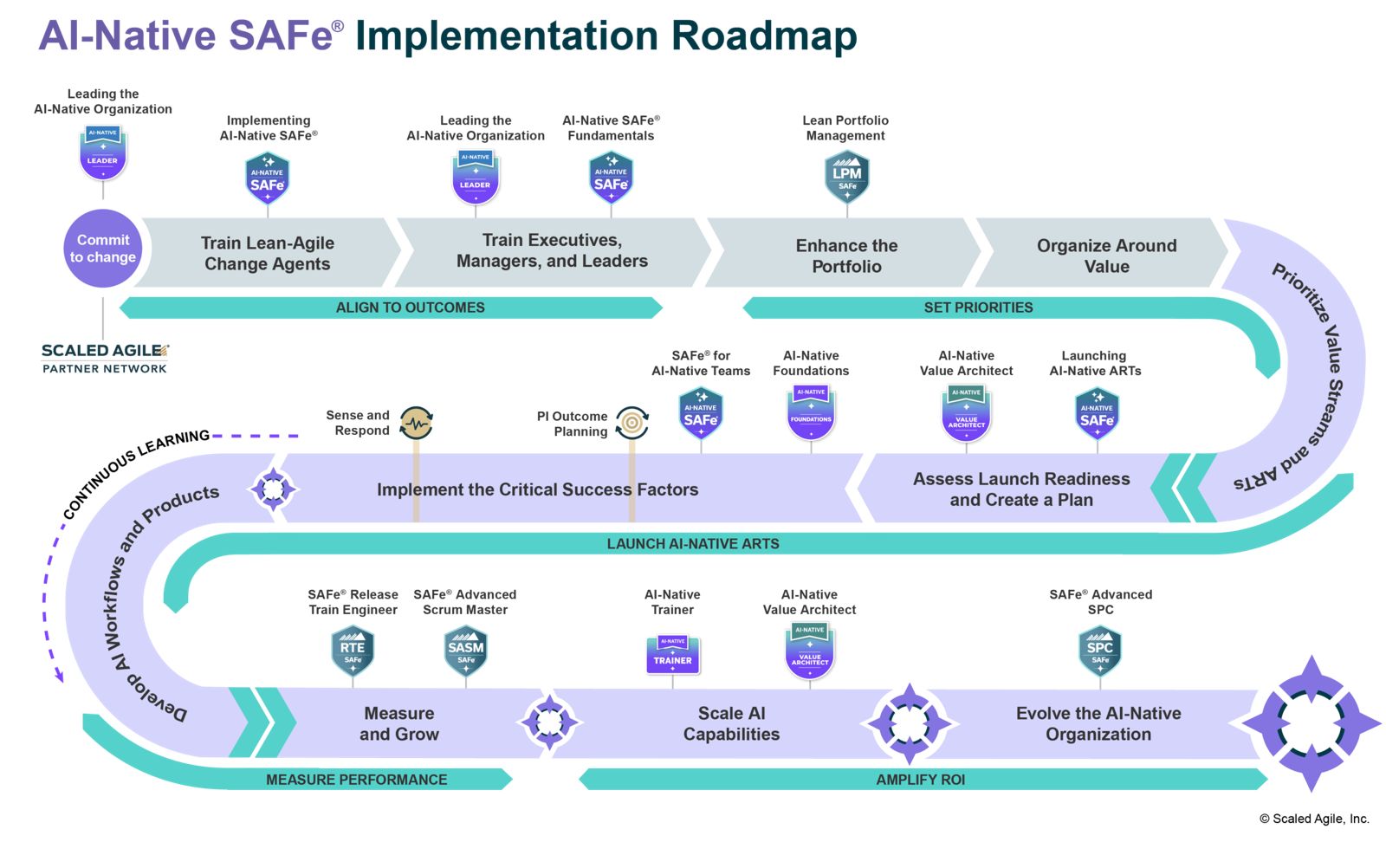
From Lean Portfolio Management to better Product Management
What sets experienced trainers apart isn’t just that they’ve seen a lot — it’s that they’ve learned to see the whole picture. They recognise connections between roles, levels and disciplines, precisely because they’ve experienced how decisions in one place ripple through to another.
When Sebastiaan delivers Lean Portfolio Management training, it rarely stays at explaining structures, decision-making or governance. Almost inevitably, the conversation turns to Agile Product Management, and to the question of why Lean Portfolio Management remains difficult in so many organisations as long as the product management role is unclear or fragmented.
He recognises that pattern from his own work. From organisations where portfolios were being set up while product vision, ownership and accountabilities hadn’t yet been properly established. Not as a theoretical observation, but as something that keeps showing up.
For participants, that’s clarifying. Not because an additional model is introduced, but because cause and effect become visible. Why prioritisation is so difficult. Why discussions keep going in circles. And where you can start on Monday with different questions and different conversations.
These are insights you rarely find explicitly in the training materials, but that give you practical footing straight away.
Why equality in the room deepens learning
Because trainers are themselves in the middle of practice, there’s no hierarchical distance in the training room. There’s no one with all the answers and a group that simply follows along. There’s a shared inquiry, where experience is exchanged and uncertainty has a place.
That’s precisely where trust is built. And that trust is the foundation on which learning deepens and translates into action.
Why Connected Movement deliberately chooses practitioner-trainers — and why learning doesn’t stop there
At a time when training is increasingly being made more efficient, shorter and more scalable, practical experience is often the first thing to go — yet it’s precisely what makes learning stick and become meaningful, even when the demands of daily reality take over again.
At Connected Movement, we make a deliberate choice not to let that go. Because learning without context stays hollow. Because development needs real stories. And because you can only truly pass something on when you’ve lived it yourself.
But learning doesn’t stop when the training ends.
Connected Movement is a community of professionals who keep finding each other, even after the training day is over and everyone is back in their own organisation. Participants are invited to remain part of that community, so that experiences don’t stay isolated, but can be shared with others facing similar questions — each from a different role and context.
By continuing to share insights, reflect together and keep each other sharp on what works and what doesn’t, a form of learning emerges that goes beyond the classroom. Not an obligation, but an open invitation to stay connected and grow together in the field.
Anyone who wants to is welcome to join.
And often finds that’s precisely where the real depth begins.