

Nobody budgets to kill anything
Series: Out-innovate your competition with your operating model — Article 2 of 5 In the first article, we showed that

Reading time
You see the price of a SAFe training and think: “Seriously? Two days of training?”
That’s a perfectly understandable reaction — and you’re certainly not alone (hence this article). Especially when you compare SAFe training with “a few workshops” or an online course you can buy for a few hundred euros. SAFe training is structured differently. And the honest answer is: yes, SAFe is often more expensive than you’d expect — and sometimes it’s not the right investment right now.
In this article, we cover:
which factors actually drive the price,
what you typically see in the market,
and how you can assess within 10 minutes whether it is worth it for your organisation.
A quick disclaimer: we deliver SAFe training, so we have a commercial interest here. That is exactly why we want to be transparent, so you can make a decision that is right for your organisation. (Which, ultimately, works out better for everyone.)
Prices vary by role, provider, country, and whether you choose open enrolment or in-company. To give you a realistic picture, here is what you typically see in the Netherlands/Benelux (usually excl. VAT, often incl. exam voucher):
Leading SAFe (2 days): roughly €1,145 – €1,595 per person
SAFe POPM (2 days): roughly €1,250 – €1,595 per person
Implementing SAFe / SPC (4 days): roughly €2,800 – €3,495 per person
Treat these as rough ranges, not gospel. The point is: you’re quickly above a thousand euros per person, and for SPC considerably more (click here for the Implementing SAFe data).
The price of SAFe training is rarely “just the training days”. You are paying for a package: official content, an exam, trainer quality, and the way you learn.
Most courses include an official exam voucher. Sometimes they also include a first year of access to the Scaled Agile platform, which gives you articles, tools and practice materials.
That is a significant difference from a generic agile training course.
With SAFe, you rightly expect someone who has experienced this in real organisations: PI Planning, portfolio decisions, product organisation, stakeholder challenges, teams hitting walls. That requires both experience and certification. That combination is scarce, and it is reflected in the price. At Connected Movement, we work exclusively with trainers who are active practitioners in the field first and trainers second. They spend 40 hours a week applying this in practice — then bring two days of that knowledge and experience directly to you.
SAFe training is most valuable when you spend a lot of time practising, discussing and translating concepts to your own situation. That typically means smaller group sizes and more facilitation. More facilitation means higher costs.
In-company training can look like “just the same training at your location”, but good providers align on context: your terminology, your setup, your questions and cases. That takes preparation time (and therefore money), but it significantly increases the chance that learning sticks.
Think official materials, licences, content updates, venue, catering, scheduling and administration. It sounds mundane, but it adds up — especially when done professionally.
Serious providers invest in keeping materials current, training their trainers, improving learning methods, and supporting participants through to the exam.
The real investment is usually: time away from work. Two days with 12 people is 24 person-days. That is where your actual business case sits.
SAFe training is worth it when the cost of miscommunication and delays in your organisation exceeds the investment. That sounds logical, but you can make it surprisingly concrete.
Ask yourself these questions:
You work with multiple teams that regularly depend on each other — and that frequently goes wrong.
Plans regularly overrun because work becomes clear too late, or because something keeps getting added.
Product, IT and business are pulling in different directions and not speaking the same language.
You want not just to understand SAFe, but to apply it consistently.
In these situations, training often leads to:
reaching shared agreements more quickly,
fewer recurring misunderstandings,
better conversations about priorities and scope,
and a shared foundation that makes subsequent coaching or guidance more effective.
Be honest with yourself here — it will save you money and disappointment.
There is no room to actually change anything (“we do the training, then carry on as before”).
There is no leadership support for making clear decisions.
Your problem is not a lack of knowledge, but something like a structurally overloaded roadmap or an unclear strategy.
In that case, you are better off starting with something else first (e.g. a short analysis, an alignment session, or coaching on the actual bottleneck).
Grab a notepad and fill in this simple calculation:
What does 1 day of delay cost?
(number of people involved × average daily cost × “loss factor”)
How often does this happen per quarter?
(e.g. every PI, every release, every month)
How much of that is caused by “we do not work the same way”?
(honest estimate: 10%? 30%?)
If the outcome is higher than your training investment, then “expensive” is often just: visible. The waste was already there.
When you compare SAFe training providers, it can feel as though you are comparing like for like. Same course name, same number of days, same price, often even “exam included”. Yet the outcomes can vary enormously.
One of the few objective signals you can look at is a provider’s relationship with Scaled Agile itself.
Connected Movement is an accredited Platinum Partner (Platinum SPCT-tier) in the Scaled Agile Partner Network.
That is the highest partnership tier in the programme.
What does that mean for you in practice?
Platinum SPCT-tier is linked to SPCT expertise. The SPCT certification is the highest certification level Scaled Agile offers, aimed at people with demonstrable knowledge and practical experience in enterprise-scale adoption and training.
Scaled Agile itself states that different partner tiers receive different benefits and support within the partner network.
In practice, that means: quicker uptake of updates, more consistent use of official materials, and faster response when content or policies change.
Scaled Agile highlights Connected Movement’s network of SPCs, SPCTs and candidates across Europe.
For you, that means above all: consistent quality and availability, even when you need to schedule multiple cohorts.
Platinum Partner is not a magic guarantee that every training will be perfect, but it is a solid quality anchor. Combine it with these three checks:
Who is leading the group, and what is their experience outside the classroom?
How much room is there for your own cases (rather than just theory)?
What happens after the training to make sure the learning actually lands in practice?
You sometimes see large price differences. These can be due to:
larger groups (less facilitation),
less experienced trainers,
less preparation and alignment,
exam not included,
or a format that is primarily one-way delivery.
Going cheap can be fine — if your goal is light-touch exposure. If you want learning to genuinely translate into behaviour and collaboration, you tend to find that you pay for quality and guidance.
Is SAFe always more expensive than a Scrum or Agile foundation course?
Usually, yes — but it is not really a fair comparison. A Scrum or Agile foundation course teaches you the basics of working in an agile way in (typically) a single team: roles, events, backlog and collaboration.
SAFe goes a step further: it builds on that Agile/Scrum foundation and explains how to organise it across multiple teams and departments simultaneously. Think about alignment between teams, planning over a longer horizon, working with multiple stakeholders, and making decisions in an environment with a lot of interdependencies.
That is why SAFe can feel more expensive: you are not just paying for “the basics”, but for a broader framework designed for more complex organisations. “More expensive” does not automatically mean “better” — it means a different level, addressing a different problem.
Can you get value from the training without taking the exam?
Yes. The exam is primarily useful if you want a measurable benchmark (and sometimes for career or role requirements). The greatest value usually lies in the shared understanding and practical application.
What is cheaper: open enrolment or in-company?
Open enrolment is often cheaper per person. In-company can become more cost-effective with larger groups, and typically delivers more contextual value. The best choice depends on group size and how specific your questions are.
SAFe training often costs a significant amount. But the price reflects more than just two days in a classroom — you are buying a combination of official curriculum, an exam, facilitation, trainer quality, and above all: your people’s time.
It is worth it if you are currently losing money through miscommunication, delays and having the same conversation over and over.
It is not (yet) worth it if your organisation has no space to act on the insights.
Register for your training now, or get in touch to discuss what works for your situation: Contact

Artikel delen
Series: Out-innovate your competition with your operating model — Article 2 of 5 In the first article, we showed that
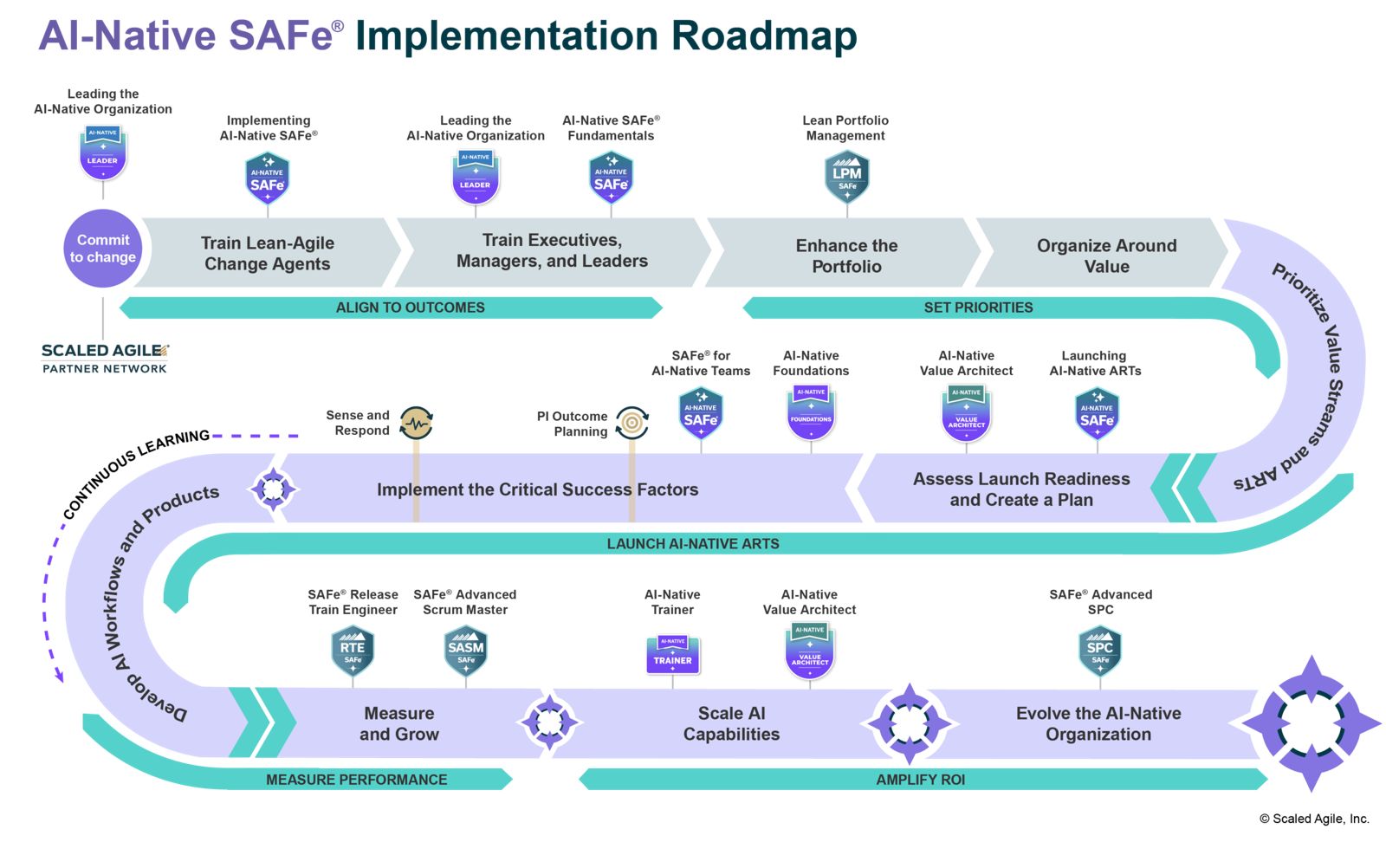
Today, 25th August is a big day for the millions of SAFe certified professionals around the globe. Scaled Agile have

AI adoption is stalling in many Dutch organisations due to a lack of knowledge, experience and ownership. According to research



Change does not have to be difficult or complex. With the right focus, energy and guidance, you create clarity, direction and results.
We would be happy to explore how we can help.
