In many large organisations, change is still organised as if it were a temporary project. There is a clear starting point, a fully worked-out plan, a programme structure with associated deliverables, and ultimately a moment at which the change can be formally considered complete. The implicit assumption is that the organisation then returns to a new form of stability.
That assumption is increasingly under pressure. Market dynamics are accelerating, technological developments are moving quickly, and customer expectations keep shifting. At the same time, internal organisational structures move too, sometimes deliberately, but often reactively. What used to be exceptional is becoming the new normal in many sectors: change no longer shows up as a phase, but as an ongoing condition.
That is exactly where the traditional “change mindset” starts to feel strained.
Continuous change requires continuous learning
When change becomes structural, the traditional model of learning also loses its obviousness. Learning can no longer be organised as a one-off intervention at the start of a programme, or as a retrospective evaluation moment afterwards. It has to become part of daily work, decision-making, and the way teams collaborate and experiment.
Many organisations are still only partially equipped for this. They typically have robust project structures, well-defined governance for programmes, and extensive reporting cycles for progress. What is often missing is a sustainable infrastructure that genuinely enables collective learning.
Without such an infrastructure, a predictable pattern emerges. Insights remain local within teams, experience disappears when team compositions change, and similar mistakes are repeated in multiple places. Progress is then experienced as fragmented, even when individual initiatives are successful in their own right. The issue rarely lies with professionals’ willingness to learn, but with a system that does not sufficiently support that learning.
From formal structures to informal networks
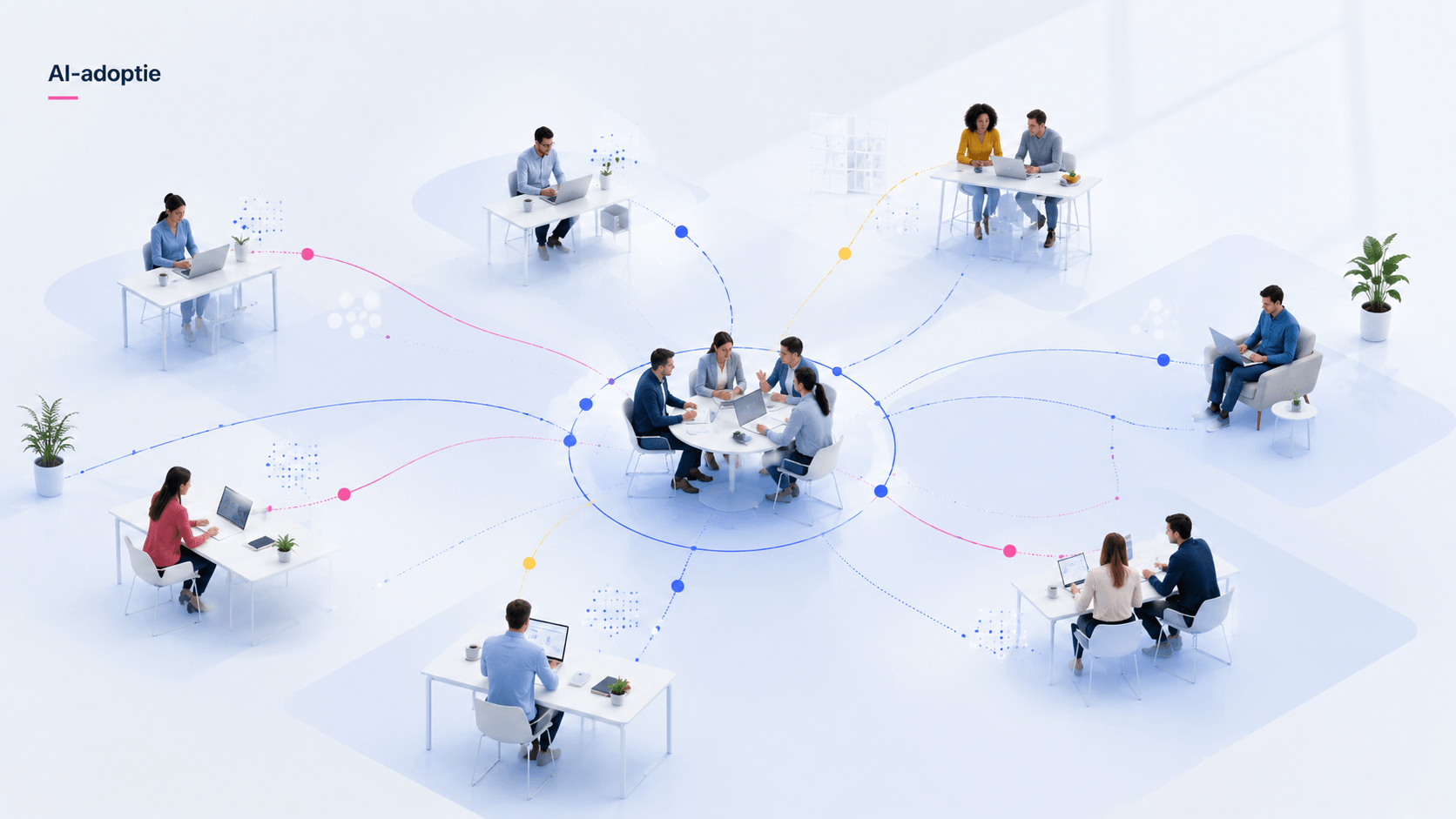
Against this background, an interesting development has become visible in recent years, often outside formal organisational design. Professionals are increasingly seeking each other out across departments, organisational boundaries, and sometimes even sectors. Not primarily because they have been instructed to do so, but because of a shared need to understand challenges more deeply.
In those interactions, a network forms in which knowledge circulates faster, experiences are reflected back, and new courses of action emerge sooner than they typically would through formal decision lines. These kinds of networks are often labelled a community, although that term does not always fully capture what is actually happening.
Their significance goes beyond connection or knowledge sharing alone. In organisations where these networks mature, they increasingly function as a supporting structure for continuous development, not built on systems or processes, but on sustained interaction between professionals.
More than an alternative to training or consultancy
It is important not to simplify this as a replacement for existing forms of intervention. Training and consultancy remain valuable in many situations, and in some contexts essential. What is changing is their relative position within the wider landscape of change.
Where training organises knowledge transfer and consultancy often provides direction or solutions within a defined period, peer networks continue to evolve while work carries on. As a result, the function of knowledge shifts: less as a transferable package and more as something that develops through ongoing dialogue.
For organisations operating in environments of permanent change, this distinction becomes more relevant. Not because traditional interventions disappear, but because they increasingly become part of a broader learning infrastructure rather than the primary vehicle for change.
Implications for leadership and decision-making
When collective learning takes on a more structural role, it has noticeable consequences for leadership and governance. The expectation that direction can be fully defined upfront comes under pressure. Instead, the emphasis gradually shifts towards facilitating conditions in which teams can learn and adjust faster.
For leaders, this means it is less about providing definitive answers and more about organising sharper questions, connecting perspectives, and creating psychological and organisational space to experiment. Decision-making does not disappear, but it is more often based on emerging insight rather than assumed certainty.
That requires a different balance between control and trust — not as an ideological stance, but as a practical adaptation to a reality in which predictability is structurally declining.
From informal initiative to strategic prerequisite
What is striking is that many of these networks start small and informal: a group of professionals who meet periodically, a recurring exchange around shared challenges, or a practice community around a specific domain. It rarely begins as a large-scale strategic programme.
That organic origin often seems to contribute to effectiveness. At the same time, in organisations where such networks mature, there is a growing recognition that something is forming that is difficult to replace through formal structures alone: a sustainable mechanism to strengthen collective learning capacity.
As a result, the status of these initiatives gradually shifts. What initially looked like an “extra” increasingly gains a more structural meaning within an organisation’s change strategy.
A shift already underway
It is still too early to claim that this shift has progressed equally far everywhere. In many organisations, it remains experimental, and the embedding in governance and strategy is limited. At the same time, the signals are consistent: professionals are seeking each other out more often outside formal lines, and organisations that can facilitate this dynamic appear to adapt faster to changing circumstances.
In the coming years, it will likely become clearer to what extent peer-driven learning structures will take a permanent place alongside existing mechanisms for change. What is already visible is that organisations that rely solely on programme-based change risk falling behind the speed at which their environment is developing.
The most relevant question may therefore shift from how change can be rolled out as controllably as possible, to how organisations can strengthen their collective learning capacity in a structural way.
Whether community-like networks ultimately gain the status of a full-fledged infrastructure for change will differ per organisation. But the fact that they are playing an increasingly visible role in how professionals navigate continuous change is now difficult to deny.
Looking for sparring, fresh perspective and practical exchange? Join the Connected Community and keep building sharper thinking and better decisions together.