

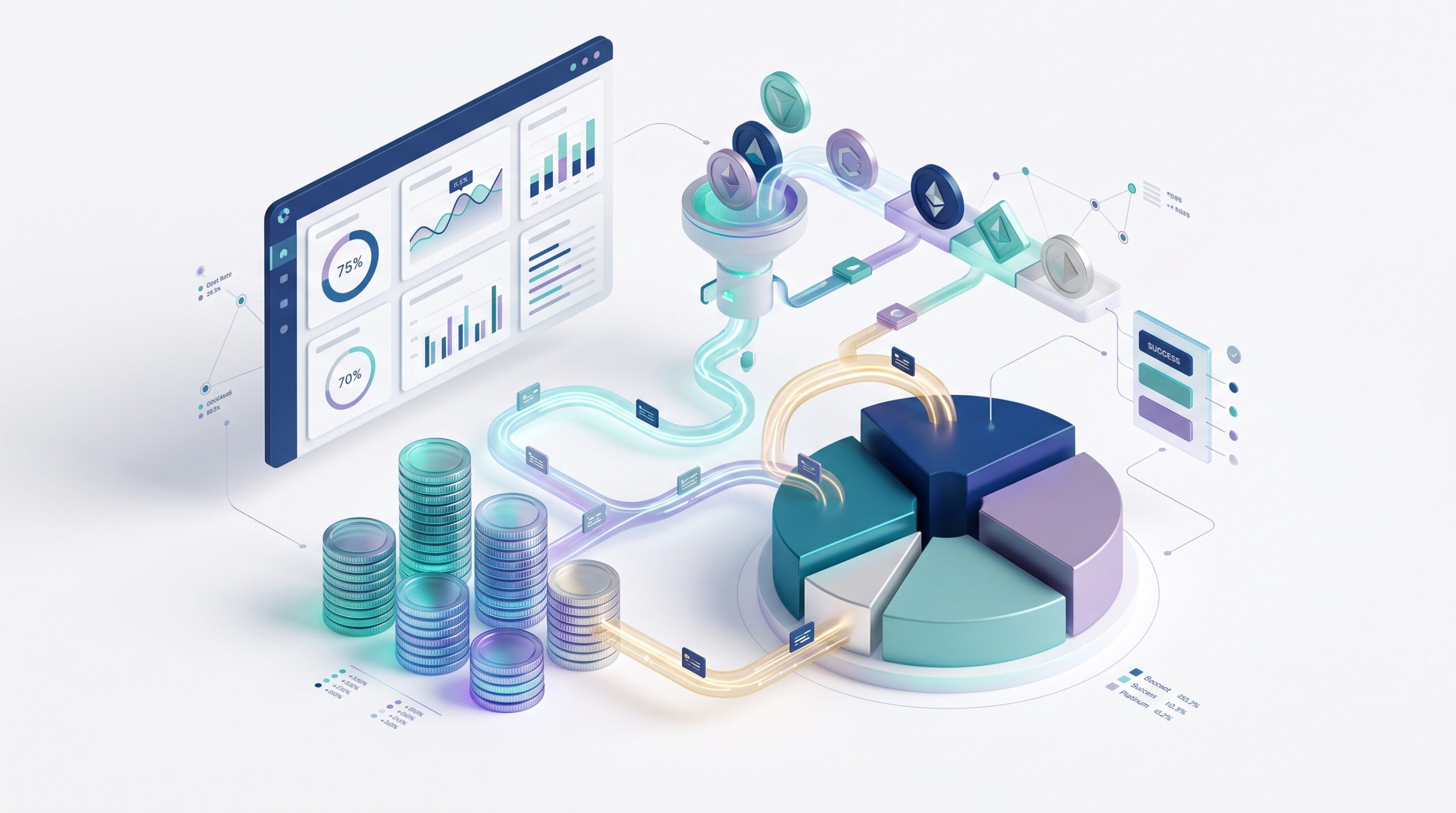
Nobody budgets to kill anything
Series: Out-innovate your competition with your operating model — Article 2 of 5 In the first article, we showed that

Reading time
Virtually every organisation has strategies, change ambitions, and growth goals. Roadmaps are created, quarterly goals are set, and investments are approved. Yet many organisations experience the same recurring frustration: daily reality does not always move in sync with the strategic direction of the organisation.
Teams are busy, portfolios become overcrowded, and management layers spend increasing amounts of time on alignment and prioritisation. Meanwhile, new initiatives emerge faster than old ones disappear, and the gap between strategy and execution slowly continues to grow.
Particularly in complex organisations, strategy itself is rarely the biggest problem. The real issue often lies elsewhere: how do you ensure that people, teams, portfolios, and investments actually move in the same direction while circumstances are constantly changing?
That is what strategy execution & alignment is all about.
Many traditional organisational models were designed for relatively stable markets. Strategy was determined periodically, translated into projects, and then monitored through governance, budgets, and reporting. That model worked reasonably well in a world where change was slower and predictability was higher.
Modern organisations, however, operate in a fundamentally different context. Technology develops faster, AI accelerates innovation, and customer expectations change continuously. This creates situations where organisations must simultaneously innovate, maintain operational stability, and react more quickly to new developments.
This makes strategy execution more complex than ever.
As a result, many organisations are discovering that extensive plans in themselves are insufficient when collaboration, decision-making, and investments are not properly aligned. Strategy execution is therefore increasingly shifting from a planning issue to an organisational issue.
One of the biggest shifts within modern organisations is the transition from static planning to continuous alignment. Traditionally, strategies were often translated into annual plans, project portfolios, and budget cycles. But in dynamic environments, these structures are increasingly failing to keep pace with the speed at which markets and technology change.
Consequently, there is a growing need for organisations that can continuously adapt strategy based on new insights. Not by creating total chaos, but by learning faster, prioritising better, and making dependencies more explicitly visible.
Alignment therefore takes on a different meaning. It is less about enforcing central control and more about creating shared direction and context. Teams must understand why certain choices are made, which strategic goals are truly important, and how their work contributes to the bigger picture.
It is precisely there that the connection between strategy and daily execution is formed.
Many organisations have now built up Agile teams, DevOps capabilities, and product-oriented structures. Yet portfolios often remain traditionally organised around projects, budgets, and governance processes. This regularly creates a gap between strategic ambitions and daily execution.
Lean Portfolio Management seeks to bridge that gap by connecting strategy, investment, and execution more closely. In doing so, the focus shifts from fixed annual plans and project funding to continuous prioritisation, value streams, and outcome thinking.
Instead of treating portfolios as a collection of separate initiatives, a more dynamic approach emerges in which organisations continuously seek to understand:
This is becoming increasingly important, especially in complex organisations.
Many organisations try to create alignment through additional governance, reporting, and management layers. In the short term, this may provide an overview, but in the long term, it often leads to more complexity and slower decision-making.
True alignment usually arises not from more control, but from clearer direction, transparency, and a shared understanding of priorities. Teams should not only know what they are doing, but especially why certain work is important and how it fits within broader strategic choices.
This requires organisations that:
Modern strategy execution is therefore increasingly less about command & control and more about organising shared context.
A key component of alignment is a shared overview. Many organisations possess vast amounts of data, dashboards, and reports, yet still lack a shared picture of what is truly important.
That is why there is growing attention for Obeya. Within an Obeya environment, strategy, operations, dependencies, risks, and progress are made visible in a single shared context. The goal is not to produce more information, but to enable better conversations.
Many organisations discover that problems rarely arise because information is completely missing. Problems more often arise because information becomes fragmented across departments, management layers, and tooling, so that no one truly has an overview of the whole anymore.
Obeya helps organisations bring strategy and execution closer together by organising shared insight and decision-making more explicitly.
Many traditional organisations are structured around functions, departments, and projects. But modern strategy execution is increasingly about value streams: how does value actually flow from idea to customer?
Much of the delay does not occur within individual teams, but rather between teams, governance layers, and hand-off points. As a result, attention is shifting more toward systems thinking, dependency management, and Value Stream Mapping.
Value Stream Mapping helps organisations make it more explicitly visible where wait times, blockages, and organisational complexity arise. This also changes the conversation within organizations. The focus shifts from local optimisation to improving the total flow through the system.
This creates a stronger connection between portfolios, teams, and operational execution.
Many organisations still primarily measure output. Budget exhaustion, roadmap delivery, and project progress often receive more attention than actual customer value or strategic impact.
But modern strategy execution requires more insight into outcomes, flow, and organisational learning capacity. Organizations want to better understand:
As a result, there is growing interest in approaches such as OKRs, benefit tracking, and flow metrics.
The challenge is that true value is often less easily measurable than traditional output metrics. This is precisely why modern alignment requires not just better dashboards, but above all better conversations about what is truly important.
One of the biggest challenges within modern portfolios is dealing with uncertainty. Many organisations continue to invest based on a false sense of certainty: extensive business cases, fixed forecasts, and linear plans.
But complex environments are becoming increasingly difficult to predict.
That is why there is growing attention for approaches such as Investment and Outcome Estimation, developed by Luke Hohmann. In this approach, organisations learn to deal more explicitly with uncertainty, scenarios, and probabilistic decision-making regarding investments and expected outcomes.
The focus thus shifts from:
“Can we predict this exactly?”
to:
“How do we make better investment decisions within a context of uncertainty?”
AI in particular is further accelerating this necessity.
AI is changing not only products and technology, but also how organisations execute strategy. Teams can analyse faster, experiment faster, and develop new propositions faster. As a result, the speed of change is increasing further.
At the same time, the risk of fragmentation grows. When delivery becomes cheaper and faster, organisations can start more initiatives simultaneously without necessarily having more strategic focus to match.
This increases the need for organisations that can:
AI Native organisations therefore often have a greater need for strong alignment mechanisms.
Modern strategy execution requires different leadership than many traditional organisations are used to. Not leadership that primarily directs through control, but leadership that creates direction, context, and focus in an environment of continuous change.
This requires leaders who understand systems thinking, dare to make priorities explicit, and provide space for teams within clear frameworks. Leadership is thus shifting from central decision-making to supporting collaboration, flow, and organisational learning capacity.
This is precisely why strategy execution almost always directly affects culture and organisational behavior.
Although almost every organisation speaks about alignment and strategy execution, the same patterns often recur. Portfolios become fragmented, governance becomes more complex, and decision-making slows down. Teams work hard, but sometimes lose sight of how their work actually contributes to strategic goals.
This regularly creates a situation where organisations are constantly changing, but experience less cohesion than intended.
Successful organisations therefore invest not only in frameworks or tooling, but also explicitly in how strategy, collaboration, decision-making, and flow are organised as a system.
Most organisations are ultimately not looking for yet another management model or extra governance process. They are looking for ways to actually translate strategy into cohesive movement.
They seek more focus, clearer priorities, better investment decisions, and a stronger connection between strategy and daily execution. But above all, they seek organisations that can learn and adapt faster without constantly losing their grip.
Strategy execution & alignment help organisations organize that cohesion more explicitly, visibly, and adaptively.
In theory, strategy and alignment often seem straightforward. In practice, they directly affect existing portfolios, governance, leadership, funding, and organisational structures.
That is why a standard framework rarely works one-on-one. Effective change requires experience with Lean Portfolio Management, Obeya, systems thinking, value streams, AI Native organisations, and modern Agile operating models.
The combination of strategy, portfolios, flow, and organisational design is becoming increasingly important for organisations that want to keep moving sustainably in a complex world.
Do you want to discover how organisations better connect strategy to execution, investment, and collaboration?
Then delve into topics such as Lean Portfolio Management, Obeya, OKRs, Value Stream Mapping, Investment and Outcome Estimation, and systems thinking. Or engage in conversation with practitioners who work daily at the intersection of strategy, portfolios, alignment, and organisational improvement in complex organisations. Join the Connected Community

Artikel delen
Series: Out-innovate your competition with your operating model — Article 2 of 5 In the first article, we showed that
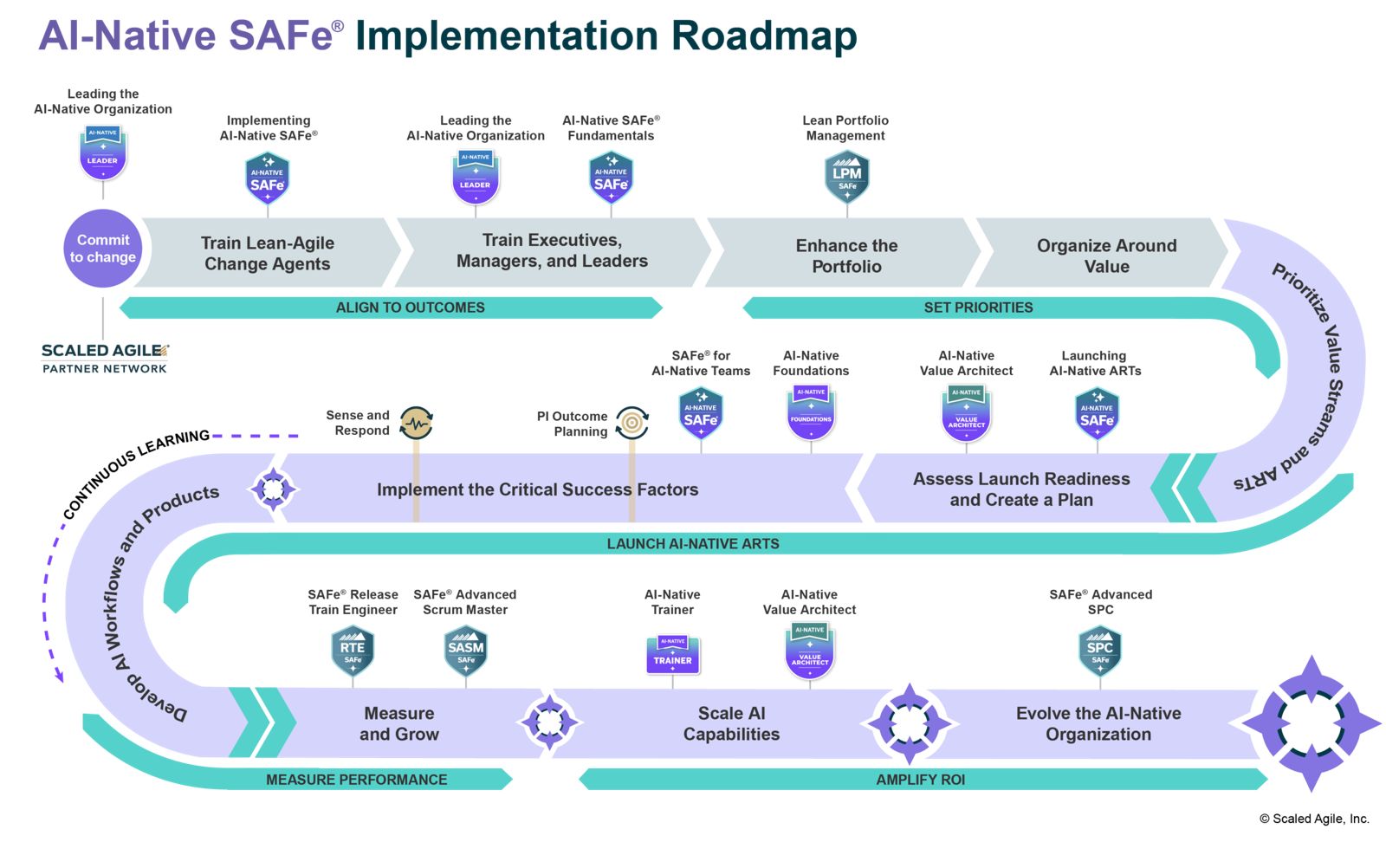
Today, 25th August is a big day for the millions of SAFe certified professionals around the globe. Scaled Agile have
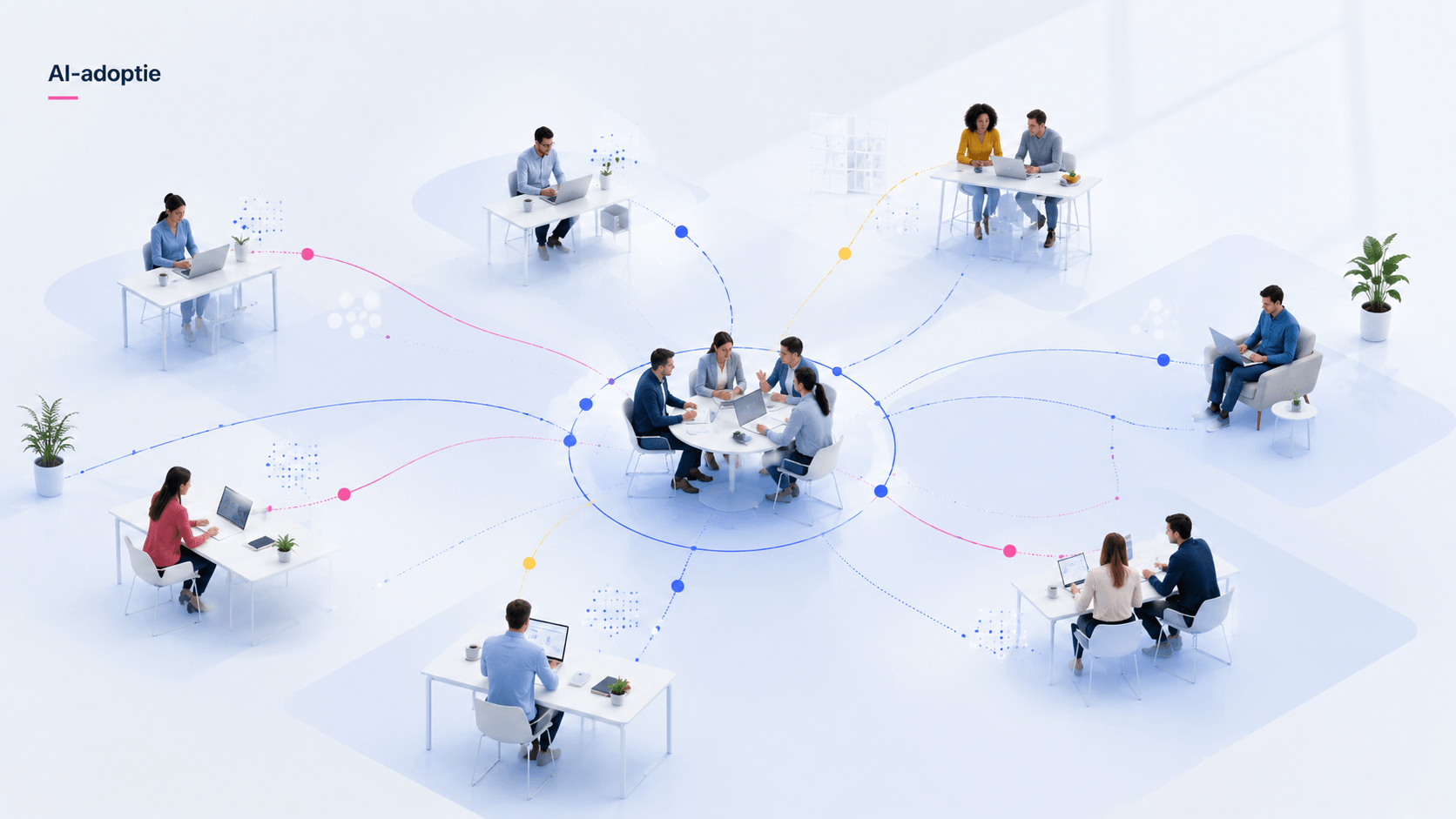
AI adoption is stalling in many Dutch organisations due to a lack of knowledge, experience and ownership. According to research


Change does not have to be difficult or complex. With the right focus, energy and guidance, you create clarity, direction and results.
We would be happy to explore how we can help.
