
Nobody budgets to kill anything
Series: Out-innovate your competition with your operating model — Article 2 of 5 In the first article, we showed that
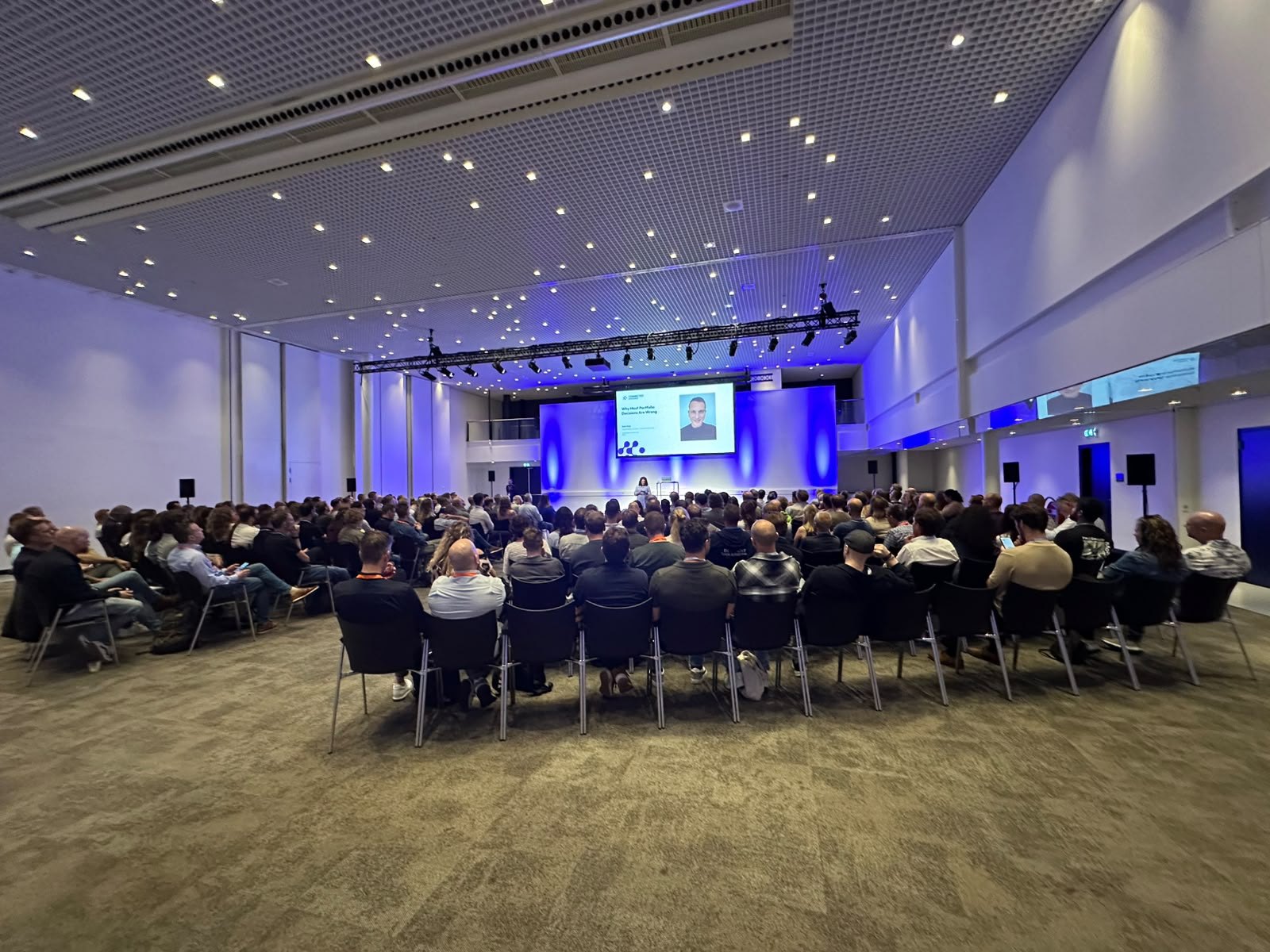

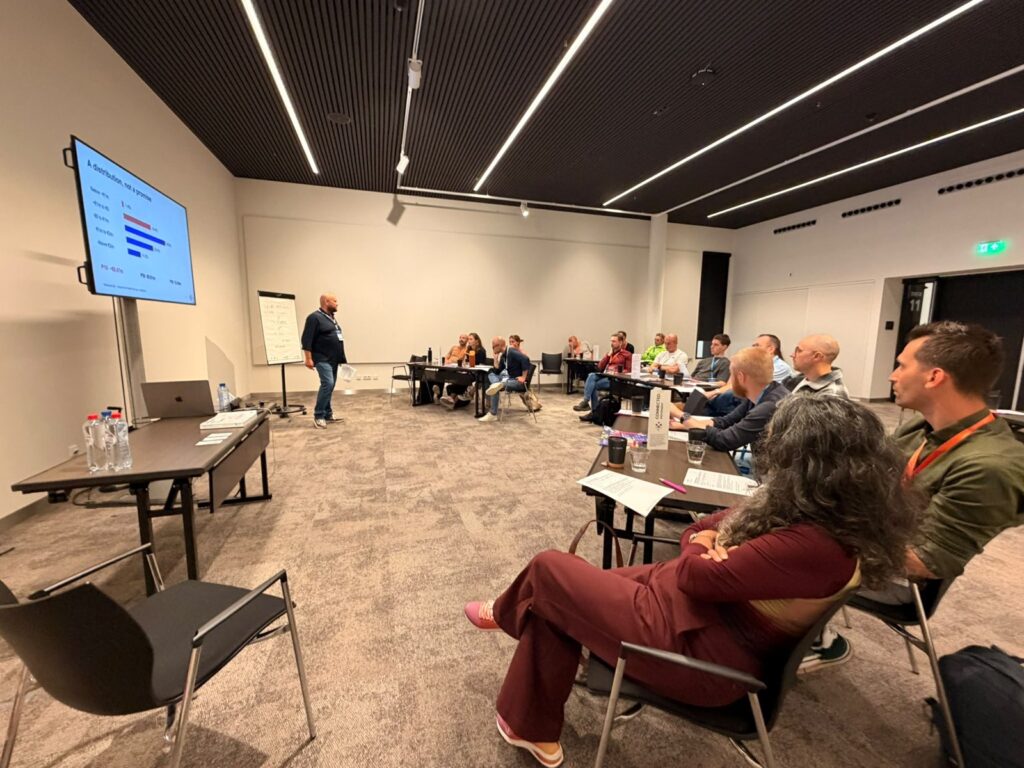
On 1 October we were at the Product Owner Event in Rotterdam Ahoy. Sukie Kang opened with a talk in the main hall, and Sebastiaan Zuiddam and Maarten Sterrenburg ran three workshops in Dock 11. All three sold out, and the conversations afterwards kept going long after the timer stopped.
The theme was not a new framework or a new tool. It was a question most product people recognise from their own budget round: why do we treat a business case as a promise, when it is really a bet?
Sukie started with a show of hands. Would you be completely comfortable letting your organisation’s portfolio process manage your pension? Not the people. The process.
Few hands went up. That set the tone for his talk, “Why Most Portfolio Decisions Are Wrongly Made”. His point was that the decisions themselves are often reasonable. What goes wrong is how they are made: once a year, on a single number, with approval treated as the end of the decision.
Initiatives come from everywhere: strategy, customers, executives, regulation, technology. Then they all arrive at the portfolio board wearing the same suit. Strategic alignment: high. Business case: approved. ROI: 17.4%. Different origins and very different uncertainty, presented with the same-looking certainty.
Sukie replaced that with three questions:
A talk can change how you look at something. It rarely changes what you do on Monday. So in the workshops we handed every participant a pen, a workbook and a neighbour, and gave them one investment decision.
The case was a fictional company, Nova Services, with a self-service portal on the table: €1.2m to build, €3.5m annual benefit at full adoption, strategic alignment high. Approve or reject. No third option.
Most rooms were comfortable saying yes. Then we asked what must be true for that benefit to appear. Customers have to want to solve it themselves. They have to actually choose the portal. That has to lead to fewer assisted contacts. And fewer contacts have to turn into costs that really disappear. Each link is an assumption, and each one can break.
Participants put their own ranges on the two inputs that mattered most. We then showed what happens when you run 10,000 combinations of honest ranges through one model: in 26 out of 100 futures, the portal has lost money after 36 months. Same case, same slide, same “high” alignment.
We voted again, this time with a third option: learn first. Many hands moved.
The first link in that chain is the one most business cases skip. They state what the company saves and say little about what the customer gains. If customers see no benefit, they will not change their behaviour, and the saving never arrives.
In the workshop we talked about a tool that makes this link concrete: Customer Benefit Cards, from the Profit Streams® approach by Applied Frameworks. Each card captures one benefit for the customer. It can be tangible, such as time or money saved, or intangible, such as certainty or control. Product management leads the exercise, and the cards go on the table with business owners and finance.
A card for the Nova Services portal could look like this:
Look at the Magnitude row. “Fifteen minutes saved” is easy to write down and hard to turn into money. The formula makes you say whose hours they are, what they cost and whether they are really freed up.
The card asks what the customer gains and also what the customer has to do to get it. That second question is where many adoption forecasts fall apart.
A handful of cards like this gives your customer research weight in the room. Interview notes and survey results become statements that finance and business owners can challenge and test. You see which customers have a real reason to switch, which benefits are assumed and never checked, and where the first small test should go. The range you put on adoption becomes something you can defend.
We use Customer Benefit Cards in the Portfolio Management Lab, where participants build them for their own initiatives before they touch the numbers.
The second half of the workshop was about timing. The business case implies a J-curve in which the full €3.5m a year arrives from the day of launch and the investment is earned back around month 16. On our example path, with fewer avoided contacts, a lower saving per contact and a six-month ramp, break-even sits around month 27, long after launch in month 12. If you wait until launch to decide again, the €1.2m is already spent.
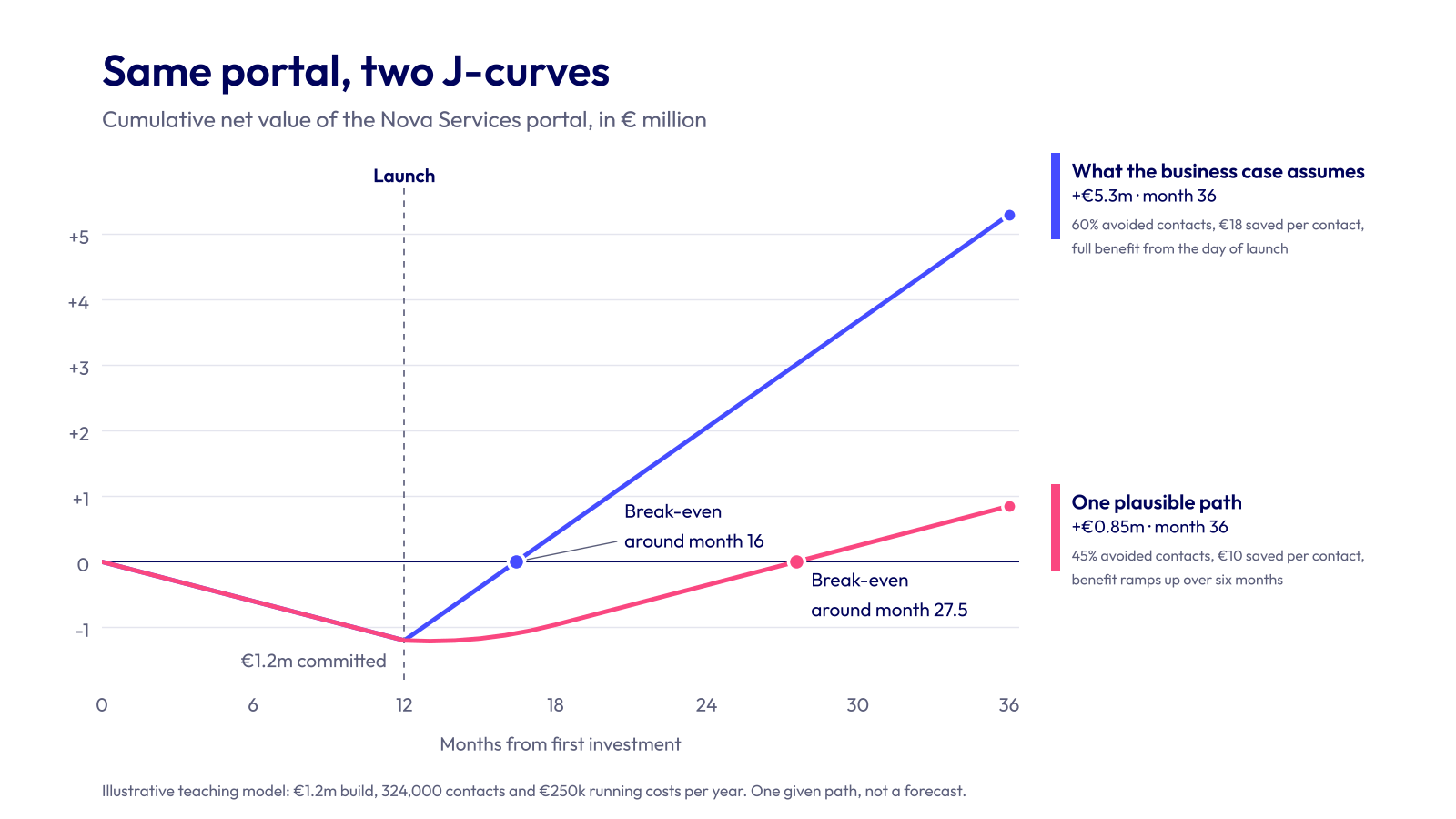
So each pair marked the moment where useful evidence should exist, and designed the smallest investment that could change the decision: which assumption to test, a maximum spend and duration, what to measure, and what they would do with the result. Sukie made the same point from the stage with different numbers: €200k buys evidence, and the €2.3m you have not spent remains an option.
Deciding again also means being able to stop. Sukie’s point here: we are much better at budgeting to start things than at budgeting to stop them. Stopping an initiative is sometimes the proof that portfolio management worked. He wrote about it in Nobody budgets to kill anything.
We heard the same things in many conversations during the day. People recognised the problem immediately. Several said they would look at their own business case differently the next morning. And many were glad the session was not only about AI.
We did talk about AI, as an accelerator of this problem. When building gets faster and cheaper, more ideas become feasible and more of them compete for the same capacity. Output was never the hard part, and it is becoming even less so. Choosing where to commit, and noticing early when a bet is not paying off, matters more.
Sukie closed with a checklist that works for any initiative on your roadmap:
None of this is ours alone. We develop this approach together with Applied Frameworks in Silicon Valley and its co-founder Luke Hohmann, co-author of Software Profit Streams™ (with Jason Tanner). As a SAFe Fellow and thought leader, Luke has had a major influence on how people think about product and portfolio management. The Customer Benefit Cards come from his work, and so does the way we use the J-curve and Monte Carlo simulation in a business case. The way we handle uncertainty also borrows from how investment banking looks at investments. We are proud to be their partner. Thank you, Luke and team.
Want to see for yourself how brilliantly this works? The concepts are embodied in the Applied Frameworks Horizon Invest platform. It comes with a free training edition that lets you experience how decision-making on range-based estimates can work for portfolio leaders.
Workshop participants have been invited by email to bring a real business case to our online clinic on Friday 9 October, 14:00–15:00 CEST. For teams that want to go further, there is the Portfolio Management Lab: twelve weeks in which portfolio managers, product managers, business owners, finance and the others who make these decisions work on their own portfolio together.
You will meet the same people there. Maarten Sterrenburg, Sukie Kang and Sebastiaan Zuiddam are our Portfolio Management Lab team.
Thank you to everyone who joined us in the main hall and in Dock 11, and to Productowner.nl for a well-organised day.
Stop trying to make the right decision once. Build a portfolio that can keep making better decisions as reality unfolds.

Series: Out-innovate your competition with your operating model — Article 2 of 5 In the first article, we showed that
Today, 25th August is a big day for the millions of SAFe certified professionals around the globe. Scaled Agile have

AI adoption is stalling in many Dutch organisations due to a lack of knowledge, experience and ownership. According to research