For Product Owners, gaining a certification has become standard practice in many organisations. Scrum, SAFe and other Agile frameworks are widely adopted and form the basis of how many professionals work. At the same time, there is growing recognition that a certification is only a starting point. The challenges Product Owners face day-to-day rarely come down to the theory behind a framework.
When theory is no longer enough
This shift was also visible at the Dutch Tax and Customs Administration (Belastingdienst). There was a clear need for a learning programme that did not simply explain how a Product Owner should work, but created space to reflect on the day-to-day reality of the role. The result was a Product Owner Gym, with practical experience, peer consultation and professional development at its core.
The starting point was familiar. Product Owners often have a solid grasp of Agile and SAFe, but in practice they face questions that have no standard answer. How do you create focus when multiple stakeholders each have their own agenda? How do you make decisions when capacity is limited and organisational pressure stays high? How do you balance short-term results with structural improvement? And how do you ensure a development team does not just keep busy, but actually delivers value?
These kinds of dilemmas are difficult to address in a traditional certification training. Certifications serve a different purpose — they introduce a shared language, explain the principles of a framework and ensure professionals work from the same foundation. Precisely because that foundation was already in place, the Belastingdienst chose a different approach.
Day-to-day practice as the starting point
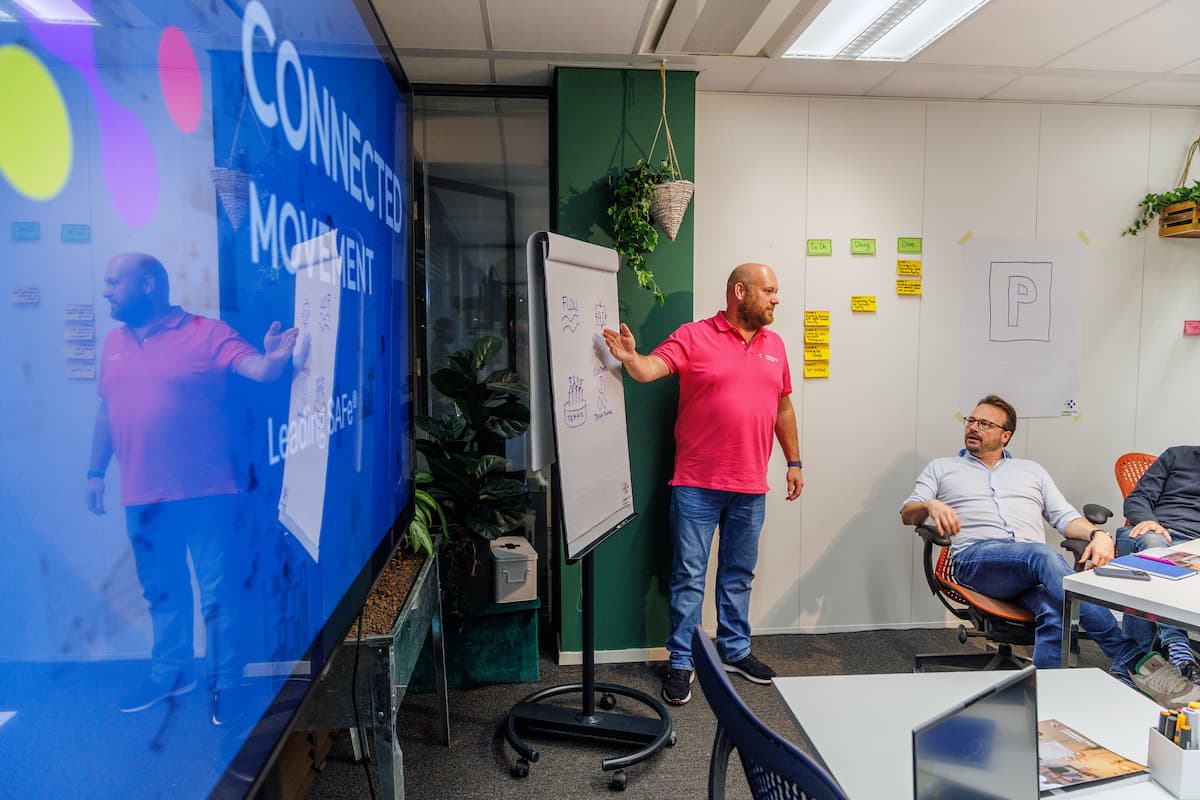
In the Product Owner Gym, participants’ own practical experience was central. They brought current cases from their day-to-day work. Conversations covered prioritisation, stakeholder management, dependencies between teams, collaboration with architecture and business, and how Product Owners can genuinely influence outcomes in a complex organisation. The goal was not to find a single right answer, but to compare different approaches and perspectives.
What stood out was that many of the challenges were recognisable across the organisation. Product Owners from different parts of the Belastingdienst were running into similar dilemmas, even though they worked on very different products and value streams. Where one person struggled with decision-making, another was stuck on the collaboration between business and IT. Beneath those differences, the same patterns kept emerging: unclear expectations, competing priorities and the ongoing search for the right balance between strategic objectives and day-to-day delivery.
Learning from peers and from practice
For many participants, the exchange of experiences proved at least as valuable as the structured guidance. Gaining insight into the choices colleagues were making gave everyone a richer sense of what the Product Owner role can offer. As a result, conversations shifted away from what Scrum or SAFe prescribes, and towards the professional judgements needed to make progress in a complex organisation.
The trainer played a different role here than in a conventional training. Not as an instructor transferring knowledge, but as an experienced practitioner who recognised similar situations from other organisations and helped surface the patterns. The value lay not in providing answers, but in asking the right questions, reflecting experiences back and connecting insights from across different organisations.
A shift that goes wider
The Product Owner Gym at the Belastingdienst is not an isolated initiative. Across both public and private organisations, interest is growing in programmes that focus on role development rather than certification alone. Where certifications primarily provide a shared frame of reference, these programmes focus on the day-to-day practice of professionals who are already fulfilling the role. That applies not just to Product Owners, but also to Scrum Masters, Release Train Engineers, Business Owners and Epic Owners.
This shift reflects a broader development in organisational development. In recent years, the emphasis was firmly on implementing frameworks. Attention is now increasingly turning to the quality with which roles are performed. Organisations are finding that the same method can produce very different results across teams, depending on the experience, decisiveness and collaboration of the people in those roles.
Expertise requires ongoing development
For Product Owners, this means that professional development is increasingly seen not as a one-off training, but as an ongoing process. Expertise does not come from acquiring knowledge alone — it comes primarily from sharing experiences, discussing dilemmas and reflecting together on complex situations from everyday practice.
This is where role-focused learning programmes show their greatest value. Not as an alternative to certification, but as a natural next step for professionals who have the theory in place and want to grow further in the role they perform every day.
Find out more about the Product Gym.