Large-scale Agile transformation in a complex government environment
When multiple transformations happen simultaneously, the challenge is rarely about teaching Agile teams to work in iterations. The real difficulty arises when business governance, portfolio decisions and large-scale delivery are not running at the same pace.
At the Belastingdienst, several change programmes ran in parallel. Business, IT and engineering were all working towards new ways of collaborating, whilst a SAFe-based way of working was being introduced at the same time. Connected Movement supported this transformation with practitioner-led training, Micro Consulting interventions and guidance on Lean Portfolio Management, Role Clarity and large-scale alignment.
The challenge
The Belastingdienst operates in an environment where continuity and change must happen simultaneously. Critical systems need to remain reliable whilst the organisation works on modernising its processes, governance and ways of collaborating.
Several transformations were running in parallel across the organisation. Different parts of the business were progressing through their own change programmes, whilst a SAFe-based way of working was being introduced at the same time. This created a complex landscape in which different rhythms, meeting structures and decision-making processes co-existed.
Whilst the ambition was clear, the practical reality was that knowledge of large-scale Agile working remained limited in many areas. Several external parties were also involved, which made it difficult to establish a shared direction and a consistent way of working.
Connected Movement was brought in to help build internal capability and strengthen the connection between strategy, governance and delivery.
“The teams quickly understood the rhythm of Agile. The real challenge was: how do you connect portfolio management, programme management and business governance to the same pace as the Agile Release Trains?”
Capability building at scale
For several years, trainers from the Connected Movement network delivered SAFe training across various parts of the Belastingdienst.
Between 500 and 1,000 professionals took part in training each year, covering a wide range of roles and responsibilities.
The focus was not on stand-alone training courses, but on developing coherent learning pathways that matched the phase of the transformation in which teams and value streams found themselves.
Teams and roles from the same value streams were deliberately trained together. This not only created a shared language, but also a better understanding of each other’s responsibilities and dependencies.
A key differentiator was the practical experience of the trainers themselves. Many were working simultaneously in other large organisations and government environments. This meant training could be continually enriched with relevant real-world examples, insights from other transformations and concrete experience of what works — and what does not — in complex environments.
Connecting training to real implementation
A core principle was that training should never be disconnected from actual implementation.
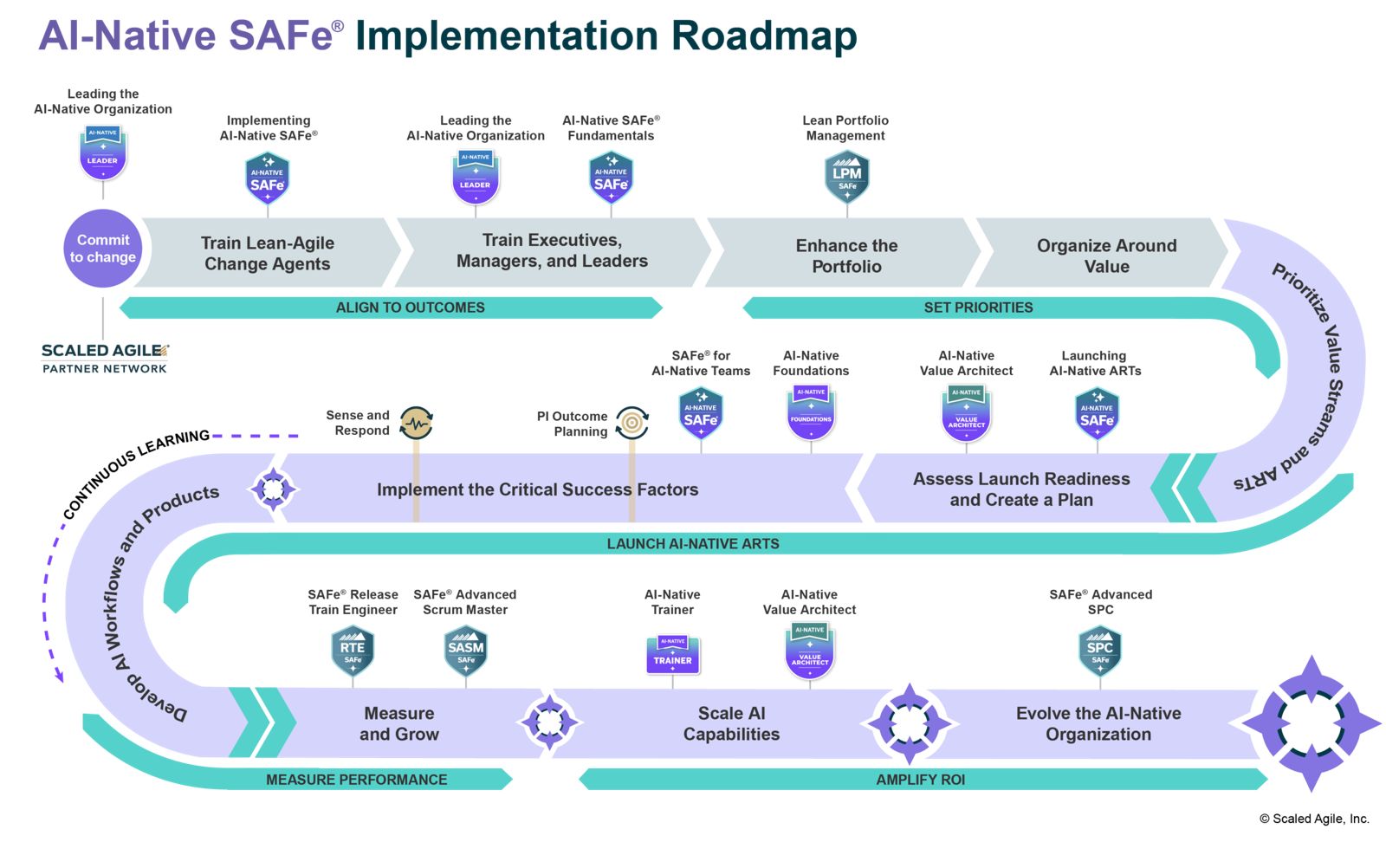
For example, training such as SAFe for Teams was deliberately scheduled just before the start of Agile Release Trains, so that teams could begin together with a shared understanding of roles, cadence and collaboration.
This ensured that training was not used purely as a theoretical introduction, but as preparation for concrete change.
Connecting business governance with Agile cadence
In many large organisations, the biggest challenge is not within the Agile teams themselves. Teams generally learn to work with iterations, joint planning and Agile delivery relatively quickly.
The real complexity often emerges above the level of teams and Agile Release Trains, where business governance, programme management and portfolio oversight still operate according to traditional structures.
That is precisely where tension between business and IT most often arose.
A key part of the collaboration was therefore connecting business governance with the cadence of Agile Release Trains.
Micro Consulting interventions
Alongside training, Connected Movement supported the organisation with targeted Micro Consulting interventions.
These short, focused interventions were designed to help entire value streams translate the new way of working into their own practice, whilst also strengthening internal ownership of the transformation.
One of the most impactful interventions was a workshop in which complete value streams jointly mapped their collaboration and governance.
Unlike traditional team coaching, these workshops deliberately focused on multiple organisational levels at once. Representatives from business, portfolio, architecture and delivery worked together to gain insight into the system as a whole.
The following roles participated, amongst others:
- value stream managers and value stream leads
- Epic Owners and portfolio stakeholders
- architects at multiple levels
- programme and project managers from the business
- Scrum Masters and Product Owners representing development teams
The aim was to make the full collaboration system visible: from strategy and governance through to delivery in Agile teams.
During the workshops, existing meeting structures, decision-making processes, investment cycles and responsibilities were mapped out together.
Whilst the rhythm of Agile teams and Agile Release Trains was often already familiar, the greatest complexity tended to emerge above ART level. Many business roles were still operating within traditional programme and project structures that did not align well with the pace of Agile delivery.
By making these structures visible together, it became clear where responsibilities did — and did not — connect with the existing ART cadence.
The workshops then helped business stakeholders better understand their role within the new way of working. Programme and project managers from the business, for example, learned how to function as Epic Owners and how strategic initiatives, investment decisions and cross-value-stream changes could connect with the planning cadence of Agile Release Trains.
Because all levels participated together, a shared understanding emerged of how the system as a whole should function. This reduced structural friction between business and IT and helped different parts of the organisation move forward together.
Strengthening Role Clarity
Another significant challenge within the transformation was role clarity. With multiple change programmes running in parallel, it was not always clear who was responsible for what — and at which level.
Introducing new ways of working creates new responsibilities, whilst existing roles and structures do not simply disappear. This frequently leads to uncertainty about ownership, decision-making and collaboration.
To make this visible, Connected Movement used the Role Mapper Method.
This helped teams and value streams gain insight into:
- current roles
- future roles
- temporary overlap between roles
- missing responsibilities within the new structure
The method proved particularly valuable in environments where change is phased and multiple ways of working temporarily co-exist.
Interactive formats were also used, such as ART Role Games and Scrum Role Games. Working through real situations together created shared understanding of responsibilities and collaboration in practice.
Lean Portfolio Management and Product Management
Within one of the value streams, work was undertaken to set up a Solution Train comprising multiple Agile Release Trains.
This structure significantly improved alignment between teams, systems and value streams. The PI Planning events that followed even attracted interest from other government organisations wanting to learn from the approach.
At the same time, Connected Movement supported the introduction of Lean Portfolio Management (LPM).
This created a stronger connection between strategy, Product Management and delivery.
Product Managers evolved from a largely reactive backlog role into a more strategic role focused on product vision, roadmaps and value creation.
In parallel, Lean Portfolio Management helped connect investment decisions, portfolio priorities and delivery more effectively.
The combination of stronger Product Management and Lean Portfolio Management enabled the organisation to bring greater focus to a very large and complex portfolio of initiatives.
From alignment to flow
As the organisation matured in Lean-Agile working, attention increasingly shifted from alignment and governance towards engineering practices and DevOps capabilities.
This is a pattern Connected Movement often sees in large organisations: first comes the need for better alignment and shared cadence, then the focus moves towards flow, engineering excellence and DevOps.
Connected Movement supports organisations in taking this next step with experienced practitioners in both DevOps and SAFe.
Impact
Results of the collaboration
Key outcomes included:
- 500–1,000 professionals trained each year across multiple roles and value streams
- stronger coherence between business governance and Agile cadence
- introduction of Lean Portfolio Management across value streams
- strengthened Product Management and portfolio focus
- greater clarity in roles, governance and collaboration
- stronger internal ownership of the transformation
- better alignment between business, portfolio and IT delivery
About Connected Movement
Connected Movement helps organisations apply Lean-Agile principles, scale product development and develop modern ways of working.
Through a combination of certified training, Micro Consulting and a community of experienced practitioners, Connected Movement helps organisations move forward in complex change environments.