
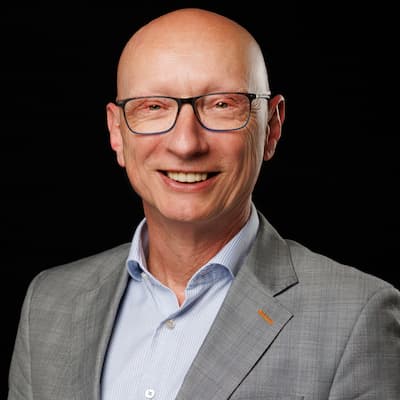
Gerard combines his background as a physicist with years of experience as an Agile coach, trainer and change practitioner. He is known for his practical approach, sense of humour and ability to cut through complexity and get to what really matters.
At Connected Movement, Gerard delivers training and coaching in SAFe, Obeya and OKR’s. He has extensive experience with organisational change, strategic alignment, scaled Agile working and building greater transparency and focus within teams and organisations. He moves with ease between boardrooms, management teams and the day-to-day reality of teams on the ground.
His strength lies in connecting theory with practice. Models, frameworks and methodologies are not ends in themselves — they are tools that help organisations actually move forward. Drawing on systems thinking, he works with organisations to explore how patterns emerge, which factors drive change and where the greatest opportunities for lasting improvement can be found.
Gerard has expertise in SAFe, Obeya and the methodologies of The OKR Institute, and helps organisations put these approaches into practice successfully.
What makes Gerard tick?
“Fun! I think it’s important that people laugh while we’re doing serious work. I also like to make things practical. As a physicist by training, I enjoy getting into theories, frameworks and models — but I always find myself asking: what can you actually do with this?
Ultimately, it’s about connecting theory with practice. I get energy from people who shape change alongside me, who discover how the system sometimes works against us and explore how we can influence it. No organisation, team or challenge is the same. That variety is what makes this work so interesting for me.”
What matters to you as a trainer?
“A training session is often about more than just the content of the course material. During training, you regularly encounter underlying themes that are critical to the success of individuals, teams or organisations. Sometimes that creates a moment of tension. I try to make that visible deliberately.
What drives someone? What is the real problem here? What has been touched on? That often leads to valuable insights.
Training makes me sharper as an Agile coach, and coaching makes me sharper as a trainer. It’s a two-way relationship. As a trainer, you need to do more than master the content — you need to be able to answer the toughest questions and help participants apply what they’ve learned in their own context.
One of the best compliments I ever received came from a group of architects — not the easiest audience. They said: ‘Your training wasn’t boring, we laughed a lot, no one fell asleep, you didn’t use too many slides, the group came closer together and we came away with practical knowledge we can use tomorrow.’ That pretty much sums up exactly what I aim for as a trainer.”
What’s your connection with Agile?
“Before I came across Agile, I was already working in line with many of the same principles. I already believed in placing challenges where the most knowledge exists — not by imposing solutions, but by encouraging teams to take ownership themselves.
When I discovered Agile, it felt immediately logical. It aligned seamlessly with how I already thought about organisations and collaboration.
My work as an Agile coach also fits well with my background as a physicist. Systems thinking plays an important role in both worlds. It’s about understanding the whole, seeing how things are connected and recognising the patterns that shape behaviour and results.
That’s why I think it’s important to work with leaders on strategy and organisational development, while also staying close to the teams that deliver value every day. It’s exactly that combination that makes lasting change possible.”
What draws you to Connected Movement?
“First of all, I get to go to places I’d never otherwise visit. I find it genuinely interesting to see how different organisations work and what challenges they face.
I also meet people I’d probably never cross paths with otherwise. And wherever you go, you find inspiring, passionate people.
What I also value about Connected Movement is the informal way of working together. We trust each other and sort things out as a team. When I recently had to cancel a training session at short notice, it was sorted quickly and a colleague stepped in.
There’s also a lot of attention given to sharing context and knowledge between trainers. For example, I deliver training at the Tax and Customs Administration, and beforehand I receive background information about the organisation, the challenges and the context in which participants are working. That allows you to connect much more effectively with participants’ day-to-day reality, and it makes the training far more valuable.
That combination of craft, collaboration and knowledge sharing is what makes Connected Movement a special place to be part of.”
The courses I deliver
Expert in these capabilities
- Leadership & transformation, Organisation Design & Collaboration, Strategy Execution & Alignment
Expert in these frameworks
- Obeya Association, OKR Institute, SAFe by Scaled Agile
Recent posts

